The old delusion of protectionism

Boston Globe: The old delusion of protectionism

… It is certainly true that people’s jobs are affected by consumers’ choices. If customers stay away in droves from Chinese hose attachments, it might well mean more work for an American hose and belting manufacturer. But why stop there? In addition to boycotting goods and services made in other countries, let’s avoid spending money on products from other states. Those of us who live in Massachusetts should refuse to buy dryer sheets from California, Ohio lightbulbs, and hoses made in California. My Boston cabbie should be curling his lip at cars made not just by companies headquartered in Japan or Germany, but by those based in Michigan, too.

Crazy? Of course. Refusing to trade across state lines wouldn’t make us economically stronger. It would make us weaker, condemning us to higher prices, less variety, reduced purchasing power, and inferior quality. Granted, such protectionism might work to the advantage of a few local producers. But it would do so only by depriving everyone else of economic opportunity and improved quality of life. To turn state borders into trade barriers would be irrational and self-defeating.

What protectionists never seem to grasp is that it is no less irrational and self-defeating to treat the borders of countries as barriers to trade. Free trade isn’t a battle that countries (or states) win or lose. It is a human right – the liberty to engage in voluntary transactions that leave both participants better off. If John wants to sell something that Mary wants to buy, it should make no difference to the lawfulness of their exchange whether they are residents of different neighborhoods, different states, or different nations. …


Comments

11 responses to “The old delusion of protectionism”

  1. Meh…
    Empirical historical data directly refutes this… …the periods were tariffs were at their highest when U.S. economic doctrine dictated such “protectionist” measures (1865-1929, 1933-1980).
    And in recent years, this scenario has played out in Asian locales where those “protectionist” nations have seen skyrocketing economic growth whereas those nations drinking the neo-classical monetarist Kool-Aid have not profited in likewise manner.
    See Ha-Joon Chang “Bad Samaritans: The Myth of Free Trade” (review here – http://blog.buzzflash.com/hartmann/023)

  2. I think the issues are bit more complex than this. I’m drawn to Paul Bairoch’s “Economics and World History: Myths and Paradoxes.”
    I think the 50 to 60 year time frames you describe are a bit to broad. Bairoch demonstrates that there have been multiple swings between liberalization and protectionism since the industrial revolution. I think he would generally support you claim that nations like the U.S. generally did better during using protectionism during the 19th and early 20th century. We were among the most protectionist. Liberalization of trade in Europe led to economic problems in the mid 19th Century and things improve when protectionism returned.
    However, since about 1960 trade is been becoming far more liberalized and it is during this time that we have seen the most astonishing improvement in life expectancy around the world and rising per capita GDP. Over the past decade or so, GDP in most large emerging nations has been growing at twice the rate of the U. S. and Europe.
    I like the analogy of medical treatment. Let’s consider post-industrialized economies as relatively healthy and emerging nations as ill. We proscribe treatments and diets for people who are ill that we would not for people who are healthy. Doing so would actually make the healthy ill. Some developing economies may need measures of protectionism to get healthy. (However, protectionism in many emerging nations is often an exercise by the wealthy elite to block competition for their own corrupt and poorly managed domestic companies.)
    There is little reason for developed nations to be practicing protectionism … particularly against poorer nations where trade would increase the wages of poor workers and reduce the costs of developed nation citizens. (Unless we are talking about blocking trade because of slave labor are other unethical destructive pratices.)
    This Jacoby’s basic premise stands: Why would we … living in an advanced economy … oppose trade with other nations but support trade between states? If there are differences then let’s name them. If not, then the protectionism makes no sense.
    When the U. S. and Europe were on the path to industrialism, protectionism may have helped (or at least not harmed.) Today it is a disaster.
    I find it incredibly ironic that the left is so supportive of open borders for immigrants and concerned about being liked by other nations at the same time, when it comes to trade, tells the rest of the world to go to hell … it’s America first!

  3. No, not a matter of telling the rest of the world to “go to hell”, more to support and protect domestic industry… …core industries hollowed out, and from a national security perspective, a precarious state to be ~100% dependent upon foreign states. Additionally, U.S. government becomes subservient to a global, undemocratic cartel of multinational corporations.
    …it is no coincidence that in the GATT/NAFTA era, the U.S. has went from world’s leading creditor/exporter to massive debtor/major importer… …it might look good on the spreadsheets proffered by corporate executive chieftains, but it’s had a terrible effect on most workers around the world — as evidenced by mass migration from Mexico in wake of NAFTA or the destruction of middle class factory jobs (which is now taking place in the white collar realm, as I can personally attest to).
    Sorry, but Jacoby has neither the experience nor credentials to assert the neoconservative FIRE focused drivel he’s emitting…
    And GDP is not the be-all and tell-all economic parameter. GDP can rise and yet the majority of citizens not profit from gains which matriculate only to the privileged few. Historically, massive inequality kindles tragic repercussions that take real form in many variants.

  4. Oh, FIRE = governance focus on Finance, Insurance, Real Estate over the interests of manufacturing…
    See Kevin Phillips excellent treatise *Wealth and Democracy* for more detail, and here’s a gentleman who’s been quite prescient in predicting future course, whereas jackals like Jacoby and others of the neoclassical economic ilk (i.e., Greenspan) who advocate shock “trickle down” capitalism that mainly impoverishes the masses with crippling debt + austerity programs while enriching a small cadre of monarchy/authoritarian family and friends…

  5. Economic interdependency is the surest safest route to preventing escalated conflicts and achieving cooperation. That is an essential element of how we achieve security is by becoming integrated world citizens.
    Yes, in opening up trade, there will be winners and losers. Yet if you protect jobs and firms from competition you create winners (protected firms and workers) and losers (consumers who must pay more for goods.) In the U. S., at the end of 19th Century, the vast majority of people worked in agriculture. Today less than 5% are. Yes, there was “destruction” of jobs. Are you suggesting we should go backward everyone working on farms? By the same token the nature of middle class jobs is changing as well. Trying to stop the change is a bit like trying to stop the move from family farms. Manufacturing industry has not left the U. S. Through technological innovation the, productivity per worker is increasing faster than the output, making fewer workers necessary … same as happened with agriculture.
    The challenge of large economic interests is always a real one. On the one hand, globalization would seem to strengthen their hand. On the other hand, globalization and a “flattening” world means almost anything that happens in the world is subject to ever more scrutiny. It is becoming harder for firms to behave with impunity and the masses have growing capabilities to organize across national boundaries against evils being done. Being atop the economic pyramid is a highly precarious to be. Studies of corporations show it is exceedingly difficult to have dominant position in your industry, much less the economy for more than a decade or so. There is more churn at the top than is often realized.
    Yes, GDP can rise while citizens do not benefit but that is not what has been happening. According to U. N. stats, the percentage of people living on less than $1 (inflation adjusted) a day in 1970 was about 39%. A couple of years ago that was 15-18% during a time when the global population doubled. Life expectancy continues to rise all around the world … now up to the late 60’s on average for the planet, a doubling from 100 years ago. I’ve given anecdotal evidence at this blog that the bottom quintile is the fastest growing quintile in Brazil. That is true in some other nations but not all by any means. I’m not trying to dismiss the challenge of checking massive corporate interests around the world but the idea that we live in the some evil dystopia with corporations sucking the life out of humanity is categorically false.
    Furthermore, a year ago Greg Mankiw had a post that highlighted 14 areas where there is strong consensus among economists from across the discipline. Here are the two tied at the top:
    1 A ceiling on rents reduces the quantity and quality of housing available. (93%)
    2 Tariffs and import quotas usually reduce general economic welfare. (93%)
    Jacoby may not be qualified to speak to these issues but certainly these economists are. The primary difference is between economists is on how well markets effectively facilitate trade and how much intervention is needed … not whether trade should be done.

  6. Yes, some of the tactics to impose market economies on emerging nations were disastrous. They failed to appreciate how deeply dependent market exchange and trade is on underlying institutions (like capital institutions, freedom of the press, remedial justice) to making these things work. They net consequence is that enriched the wealthy elite with little and often negative impact for the masses. Books like Hernando DeSoto’s “Mystery of Capital” do a great job of illustrating the cultural elements involved and how blind we frequently are to them.
    I’m having a hard to understanding what this has to with Americans locking out others … especially those from poorer nations … being able to sell their goods in the U. S.

  7. Mankiw and those guys were far off the mark in their prognostications and assessments… …meanwhile, Chang, Phillips were totally on the mark…
    Bad analogy with farming as factory jobs, white collar work more than swallowed up those displaced (not without transitory pain but while jobs diminished in the fields, they grew in offices, factories, universities, etc.…). No parallel to today, where they only growing job fields are in health care and low wage positions that will easily be replaced with robotics, drones and/or cheaper overseas labor.
    Yes, GDP can rise while citizens do not benefit but that is not what has been happening. According to U. N. stats, the percentage of people living on less than $1 (inflation adjusted) a day in 1970 was about 39%. A couple of years ago that was 15-18% during a time when the global population doubled. Life expectancy continues to rise all around the world … now up to the late 60’s on average for the planet, a doubling from 100 years ago. I’ve given anecdotal evidence at this blog that the bottom quintile is the fastest growing quintile in Brazil. That is true in some other nations but not all by any means. I’m not trying to dismiss the challenge of checking massive corporate interests around the world but the idea that we live in the some evil dystopia with corporations sucking the life out of humanity is categorically false.
    Furthermore, a year ago Greg Mankiw had a post that highlighted 14 areas where there is strong consensus among economists from across the discipline. Here are the two tied at the top:

  8. I don’t know what prognostications you’re referring to? Concerning what?
    The surveys encompassed the entire spectrum of economists which includes a number of views. As one comedian says concerning economists and predictions, “You could lay all the economists end to end and still not reach a conclusion.” 🙂 That is why this point of agreement about the importance of trade is so striking.
    During the time that farmers were moving off their land into cities there was no foreknowledge of the jobs and industries that would emerge. It was very much the same as it is today. Over the puts two centuries since the inception of the Industrial Revolution there has been an undulating movement between times where technology drives advances in production (benefiting the owners of the technology and disrupting the nature of the job market) followed by times where the new industries the technology creates a excess demand for new types of labor(good for labor.) We have been in a major technology productivity phase lately that I expect is coming to an end and the new industries (and jobs) that will grow are still not quite clear. Yes, health car jobs are growing at the moment but we are also in the middle of major recession. As recovery gets underway we will begin to see what the economy looks like.
    I presume when you talk about Phillips getting right you are talking about the finance industry. I’ve been saying for years that America’s lack of savings is a major concern. Many banks and Credit Card companies have largely become parasites (That is combination of both government negligence … by Dems and Reps … and bad busienss.) Many have been suspicious about the mortgage market for years, including myself. What was not fully appreciated until the financial crisis was just how deep the lack of transparency went.
    I haven’t read Philips books but what I have read and seen of him does not impress me. I don’t have much more use of aristo-populism than I do for the populist Right. Philips does not get most things right and I think Jacob Weisberg captures the perception I have of Philips take on things. Click here.

  9. A political journalist takedown of Phillips on economics? Really?
    I’ve not read his Theocracy book (which sounded like a rehash of a lot separate data dumps), but Phillips track record of predictions has been most prescient. Tons more so than Weisburg, Mankiw, etc.…
    Wealth and Democracy (written ~2000) tracks metamorphosis of American economy into FIRE (Finance/Insurance Real Estate) focus over trumping manufacturing that happened in the 1980s (as well as a historical sketch of past economic empires that followed a similar arc — British, Spanish, Dutch).
    Regarding Mankiw’s “consensus”, no source is provided, and anyone could proffer a similar “consensus” of center/left leaning economists that dispute such sophistry (see Economic Policy Institute or Center for Economic Policy Research or real left economists).
    Country has been under Republican control since 1980. Clinton two terms were essentially Republican-lite (and according to Alan Greenspan, Clinton was best “Republican” he served under, with the closest matching economic policy). In that time span, U.S. has gone from largest creditor/exporter to leading debtor/importer of finished goods. Those are the facts and Phillips (while certainly no saint and no doubt error riddled in other regards) called them out years ago whereas Pollyannish dupes like Mankiw continued to serve up neoconservative/neoliberal Kool-Aid.

  10. Irrespective of Phillips, the more salient point is that the empirical evidence history illustrates completely refutes you and Mankiw’s economist consensus… …in 19th-20th century U.S. and in 20th-21st century nations Korea/Japan/China… …and worse, in the U.S. economic fortunes post 1980, since the Hamiltonian/Keynesian model was discarded in lieu of a globalist/monetarist model…

  11. “Tons more so than Weisburg, Mankiw, etc.…”
    Again, I don’t know what predictions you are talking about. (And BTW, I’m sure Weisburg … editor at Salon … would be interested to know he is in the same camp with Mankiw.)
    As to the survey Mankiw reports, he gave this list once before and as I recall the biggest sampling was of Phd’s in the American Economic Association, the premier and most representative association of economists. It includes economist from across the entire spectrum. Again, as I said above, the primary difference between economists is on how well markets effectively facilitate trade and how much intervention is needed … not whether trade should be done.
    As to FIRE, if percentage of the economy (GDP) from manufacturing is the ultimate measure then these are the three most prosperous and secure economies in the world based on 2005-2006 data:
    Swaziland = 36.8%
    Thailand = 35%
    China = 33.5%
    Belarus = 32.8%
    Meanwhile nations with less than half this percentage in manufacturing would be less prosperous:
    U.S. = 14.4%
    U.K. = 13.6%
    Denmark = 14.2%
    France = 12.4%
    Australia = 11.0%
    Almost every nation that has high per capita income today has a smaller percentage of its GDP coming from manufacturing than it did 20 and 30 years ago. Manufacturing is particularly influenced by technology and economies of scale. More and more goods can be made by less and less people through the application of technology. These factors led to ever less waste in production, more features for the same money and usually better quality. (ex. A microwave today costs less in real dollars than 20 years ago yet it is has more features, is more durable, and uses less energy.) This process won’t work in other fields.
    I posted an article yesterday where economist William J. Baumol (a Democrat) talks about “cost disease.”
    “Dr. Baumol and a colleague, William G. Bowen, described the cost disease in a 1966 book on the economics of the performing arts. Their point was that some sectors of the economy are burdened by an inexorable rise in labor costs because they tend not to benefit from increased efficiency. As an example, they used a Mozart string quintet composed in 1787: 223 years later, it still requires five musicians and the same amount of time to play.
    Despite all sorts of technological advances, health care, like the performing arts, suffers from the cost disease. So do other public services like education, police work and garbage collection. While some industries enjoy sharp increases in productivity (cars can be built faster than ever, retail inventory can be managed better), endeavors like health care are as labor-intensive as ever.”
    Therefore, things like insurance, real estate, and health care are resistant to the economic factors that drive down costs in manufacturing. As we move into a post-industrial economy, manufacturing will recede in size relative to these other industries, even as the quantity of goods produced expands. That is a sign of economic health and prosperity, not the machinations of an evil corporate conglomerate.
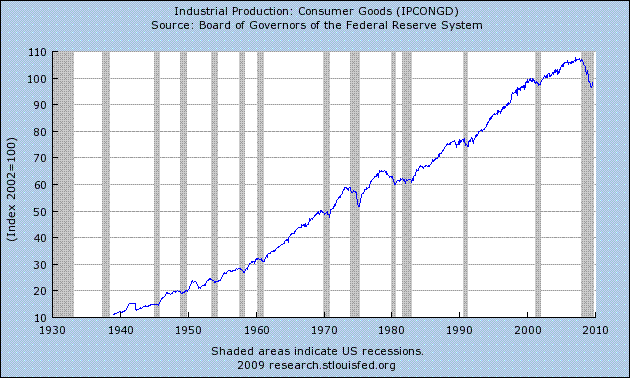
    The transition from poor nation, through emerging nation, to prosperous nation, is a bell shaped curve. At the beginning there is little manufacturing. As they move into an industrial mode, manufacturing radically increases as percentage of the economy. As they move into post-industrialism manufacturing recedes in importance partly for the reasons above and partly because people now have more disposable dollars they want to spend on things like entertainment, travel, and health care. Thus the name, “post-industrial.” Notice in this graph that, barring recessions, American manufacturing has been growing at a steady rate for seventy years. The difference is that prosperity has created a rising demand for non-manufactured goods, causing these goods to become a greater piece of the overall economy.
    The primary way emerging nations can improve their economies is by having places to sell excess goods as they become more productive. Yes, as acknowledged above, some nations moving through phases of industrialization engage in some level of protectionism. It is likely necessary. But I bring this full circle. The article is not about protectionism in emerging nations. It is about protectionism the post-industrial society of the U. S. over a false notion that American manufacturing is going into decline and that an economy dominated by manufacturing is somehow the holy grail of economic prosperity. It is an attempt to artificially keep wages high and industries operating. The result is smaller markets for the goods made by the poor in emerging nations, stunting their emergence toward prosperity, while creating higher prices for goods for us … merely delaying the inevitable creative destruction of old industries and hampering the emergence of new ones.
    Peace!

Leave a Reply to NaumCancel reply

Discover more from Kruse Kronicle

Subscribe now to keep reading and get access to the full archive.

Continue reading